

What Should You Fix Before Selling Your Portland Home?
Portland sellers don’t need to renovate before listing — but they do need to know which repairs protect their net proceeds and which ones are a waste of money. In a balanced 2026 market, move-in-ready homes in good condition sell in 19–21 days; underprepared homes sit for 60–80 days and draw price-reduction requests. The right pre-listing investment depends on your home’s age, condition, and price point — not on general renovation advice.
The question I hear more than almost any other is some version of this: “I want to sell, but I don’t know what to fix first — or whether I should fix anything at all.”
It’s a smart question. And in Portland’s 2026 market, it matters more than it did three years ago.
When demand was outrunning supply, buyers overlooked almost everything. Today, they have choices. They’re comparing your home against four others in the same price range. They’re hiring inspectors who look at everything. They’re factoring deferred maintenance into their offers — or walking away entirely.
But that doesn’t mean you should renovate your way into a sale. It means you need a clear-eyed assessment of what moves the needle in this market and what doesn’t.
As a Licensed General Contractor who works exclusively in Portland Metro real estate, this is the exact evaluation I walk every seller through before we go live.
The Portland Repair Checklist That Actually Matters
There’s no universal answer, but Portland’s housing stock has a consistent set of age-related vulnerabilities that buyers know to look for — and that inspectors always flag. Here’s where to start.
Sewer Scope ($150–$250)
This is the most Portland-specific item on this list, and the most underestimated.
Most of the city’s older neighborhoods were built with clay tile sewer lines. Clay tile was standard from the late 1800s through the mid-twentieth century, and in a city with large street trees and heavy clay soils, root intrusion develops over decades in nearly every line that hasn’t been replaced or relined.
Every Portland buyer orders a sewer scope. It’s not optional — it’s expected. If your home was built before 1985, you should scope it before you list. Homes built before 1960 are near-certain to have clay tile and should be treated as high-priority.
Why do this before listing rather than waiting? Because discovering a failed lateral during the buyer’s inspection gives them enormous leverage. A $150 scope on your terms becomes a $20,000 negotiation on theirs. If there’s a problem, it’s far better to know what you’re dealing with, price accordingly, or address it before it derails a deal in escrow.
Replacement costs $8,000–$25,000 for a full lateral. Lining typically runs $3,000–$8,000. Both are negotiable — but only if you control the timing.
Roof Maintenance and Moss
Portland’s climate is hard on roofs. Moss, algae, and debris accumulation accelerate deterioration, and inspectors always flag them.
If your roof has significant moss growth, have it professionally cleaned and treated before listing — typically $300–$800. This isn’t the same as replacing a roof, and it shouldn’t be confused with one. A clean, well-maintained roof signals to buyers that the home has been cared for. A moss-covered one signals the opposite.
If your roof is genuinely at end-of-life (15+ years on composition shingles in Portland’s wet climate), your agent should help you think through whether to replace or price for the condition. A roof replacement generally runs $15,000–$25,000 depending on size and material. In some cases it makes sense; in others, the better move is full disclosure and an adjusted price. I’ll give you a straight answer on which applies to your home.
Moisture, Drainage, and Crawlspace
Water intrusion in basements and crawlspaces is the single most common inspection finding in Portland Metro. It’s also one of the most emotional triggers for buyers, who interpret moisture as a sign of structural neglect.
Before listing, check:
- Grading around the foundation — water should slope away from the house
- Downspout extensions — water should discharge at least 4–6 feet from the foundation
- Crawlspace vapor barrier condition — torn or missing barriers are a common finding
- Any visible efflorescence (white mineral deposits) or staining on basement walls
Many of these are low-cost fixes — often under $500. But left unaddressed, they produce inspection reports that read alarming and give buyers grounds to renegotiate. This is exactly the kind of thing your listing inspection — or a pre-listing walkthrough with a GC — will catch.
Fresh Paint and Cosmetic Presentation
Interior paint refresh consistently recovers more than it costs. Small investments in neutral, fresh color — particularly in living areas, kitchens, and primary bedrooms — make homes photograph better, show better, and feel better.
You don’t need to paint the entire house. Focus on the rooms that photographs most prominently and any rooms where the existing color is polarizing or the paint is visibly worn.
Exterior paint condition matters for first impressions and for the appraisal. Peeling exterior paint on a home over 1978 raises lead-based paint flags on FHA/VA transactions. If your exterior paint is in poor condition, address it.
Entry Door, Garage Door, and Curb Appeal
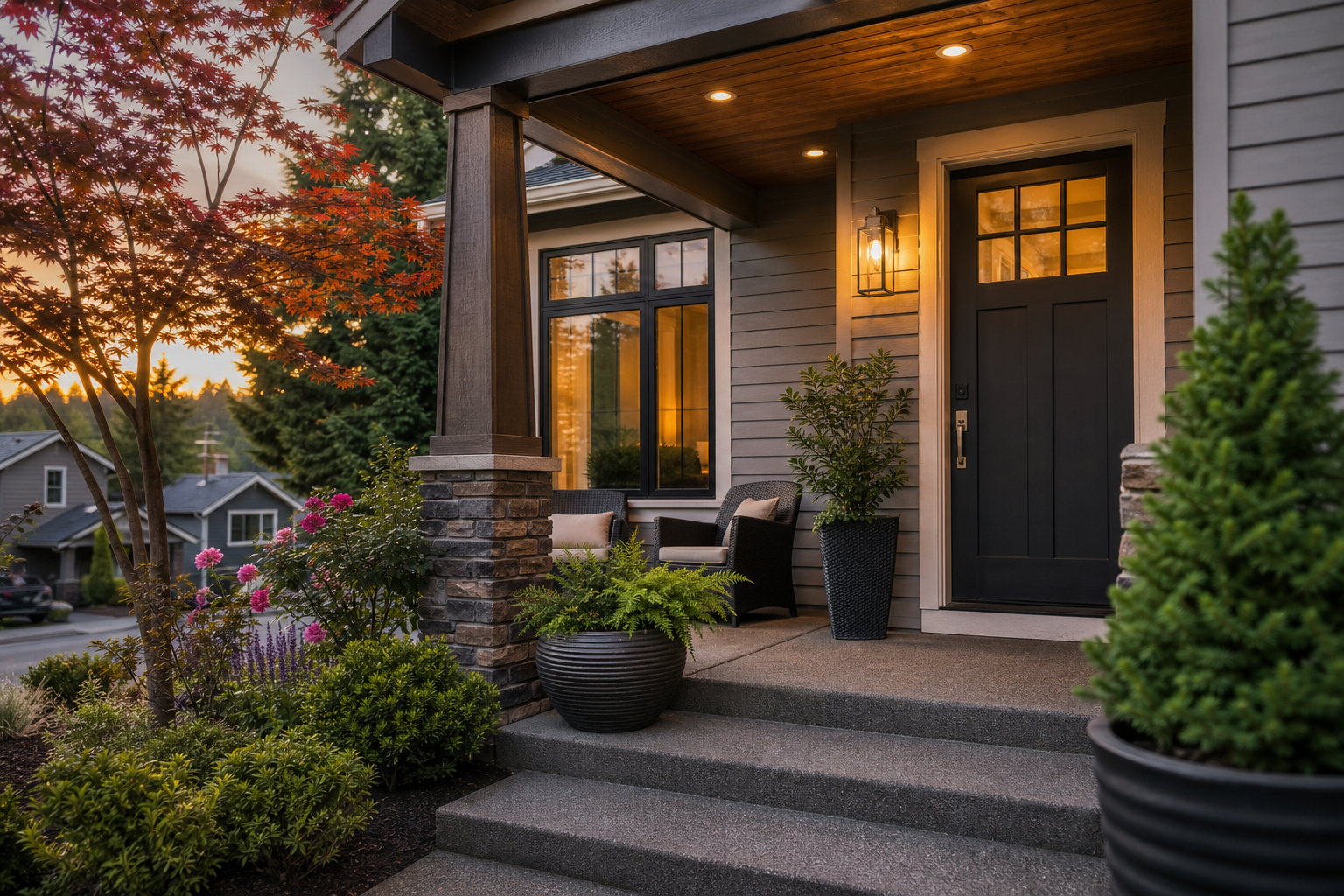
These are the highest-ROI investments you can make before listing. A steel entry door replacement consistently delivers over 200% ROI. Garage door replacement tops every return-on-investment study year after year.
Buyers form their first impression before they walk through the door. Your agent’s job is to make them want to walk through it. Clean, well-maintained landscaping, fresh mulch, and functional, attractive entry presentation signal that the rest of the house will be the same.
This doesn’t mean a full landscape overhaul. It means trimmed beds, a working mailbox, clean pathways, and a front door that doesn’t embarrass itself.
What to Skip
Knowing what not to fix is just as important. Here’s where sellers routinely overspend without meaningful return.
Major kitchen or bathroom remodels. A full kitchen gut renovation returns roughly 49–60% of its cost at resale. You’re spending $60,000 to add $30,000–$36,000 in sale price, which means you’re leaving money on the table to complete someone else’s renovation preferences. Buyers in the $700K–$1.5M range often want to renovate to their own taste anyway. A clean, functional kitchen that doesn’t need immediate attention is more valuable than a newly renovated one that doesn’t match buyer preferences.
Minor cosmetic issues that are clearly wear-and-tear. Small wall dings, minor scratches on hardwood, aging but functional appliances — these don’t cost deals. Buyers expect a lived-in home to have lived-in details. What they can’t tolerate is deferred maintenance on systems.
Luxury upgrades. Smart home systems, elaborate hardscaping, new irrigation, custom window treatments — none of these meaningfully move your sale price. Portland buyers value condition and location over luxury add-ons.
Unfixable property conditions. If your home backs to a busy arterial, sits under a powerline easement, or has a lot that’s smaller than the neighborhood norm, no amount of renovation offsets those facts. Buyers who are the right fit for your home will see past them. Buyers who aren’t the right fit won’t, regardless of what you renovate. Price accurately and market strategically — that’s the real answer.
The Pre-Listing Inspection Question
Should you get an inspection before listing? In most cases, yes — especially for Portland homes over 20 years old.
A pre-listing inspection ($400–$600) lets you see what the buyer will see before they see it. You get to address the issues you choose to address, price for the ones you don’t, and disclose everything in a way that builds rather than destroys trust.
The risk is real: a pre-listing inspection can reveal expensive problems you’ll need to disclose under Oregon’s OREF 020 Seller’s Property Disclosure Statement. But those problems exist whether or not you inspect for them. Finding them on your timeline is almost always better than finding them on the buyer’s.
One thing I always tell sellers: knowing the true condition of your home isn’t a liability. It’s a strategy.
The Financial Frame
Here’s the question that drives all of this: what’s the ROI of the repair relative to the risk of not doing it?
A $200 sewer scope that reveals a $5,000 relining job is a completely different calculation than a $25,000 full lateral replacement. A $600 pre-listing inspection that surfaces two fixable issues worth $3,000 total is a very different calculus than one that surfaces foundation problems.
The repair-or-price decision always comes back to your specific home, your specific timeline, and the current market dynamics in your neighborhood. In the Portland 2026 market, buyers are financially stretched and using inspection findings to negotiate price reductions and credits. Your best defense is to know your home’s condition before they do.
If you’re thinking about listing in the next 60–90 days, the most valuable thing you can do right now is a pre-listing walkthrough with someone who can give you an honest assessment — not a sales pitch for renovations that won’t pay off.
That’s exactly what a free consultation with me delivers. I walk your home like a contractor and a strategist. We figure out what’s worth doing, what’s not, and what will protect your net proceeds.
To understand how those repair decisions affect your final number, see How Much Will You Net Selling Your Home in Portland, Oregon? And if you’ve already accepted an offer, Buyer Repair Requests After Inspection in Portland: Fix It, Credit It, or Push Back? covers what happens on the other side of that inspection.
If your home is in the City of Portland limits, don’t overlook the required Portland Home Energy Score disclosure — it needs to be completed before you go live on RMLS.
Frequently Asked Questions
Should I get a pre-listing home inspection before selling my Portland home?
In most cases, yes — especially if your home is over 20 years old. A pre-listing inspection ($400–$600) lets you identify and address issues before the buyer’s inspector finds them. Oregon’s OREF 020 Seller’s Property Disclosure Statement requires you to disclose known defects, so it’s always better to know what you’re dealing with before an offer is on the table.
Is it worth replacing carpet before selling a house in Portland?
It depends on the condition and the price point. Visibly worn, stained, or odor-laden carpet is a real deterrent and should be replaced — typically $2–$5 per square foot installed. If the carpet is dated but clean and functional, a thorough professional cleaning ($200–$400) is often sufficient. At the $700K+ price point, buyers frequently plan to install hardwood or update flooring themselves — full replacement may not be necessary.
Should I renovate my kitchen before listing my Portland home?
Not if it means a full gut renovation. A major kitchen remodel typically returns 49–60% of its cost at resale — meaning you spend $60,000 to add perhaps $35,000 in value. Unless your kitchen is functionally broken (failing appliances, water damage, no workspace), a thorough clean, fresh hardware, and a paint refresh will do more for your sale price than a renovation. Save the renovation budget for the buyer.
Do I need to fix foundation drainage before selling in Oregon?
You don’t have a legal obligation to fix it — but you do have an obligation to disclose it under Oregon’s OREF 020 form. If your home has grading or drainage issues that allow water to migrate toward the foundation, buyers will negotiate hard for repairs or price reductions when their inspector flags it. In most cases, correcting exterior drainage is a $300–$1,500 fix that prevents a $5,000–$15,000 negotiation. Address it before listing.
What repairs do Portland buyers most often request after inspection?
In Portland’s older housing stock, the most common buyer repair requests involve: sewer lateral condition (clay tile issues, root intrusion), roof maintenance (moss, damaged flashing, aging shingles), moisture-related findings (crawlspace, drainage, minor water intrusion), HVAC service history, and electrical panel concerns in older homes. Addressing the first three proactively before listing significantly reduces the likelihood of post-inspection renegotiation.
The Bottom Line
The smartest pre-listing strategy isn’t the most expensive one — it’s the most targeted one.
Portland’s 2026 market rewards sellers who present their homes honestly, address the issues that matter to buyers, and price accurately for what remains. It penalizes sellers who overspend on renovations that won’t return, or who list without knowing what’s in their crawlspace.
The walk-through I do before a listing goes live is different from what most agents offer, because I look at your home as both a broker and a contractor. I’ll tell you what to do, what to skip, and what to disclose — so you’re not guessing when the buyer’s inspection report arrives.
Thinking of Buying or Selling? Schedule a Free Consultation.
About Pascha Cain, Real Estate Broker
Pascha Cain is a Portland Metro Real Estate Broker, Investor, and Licensed General Contractor and a former Nike/Adidas global executive. She works with visionary sellers and buyers who know that strategy and marketing win in real estate. Connect with Pascha at pascha@pascharealty.com